What makes us who we are?
The enjoyment of poetry and the delight in philosophical conversation are what set human beings apart. Humanity’s deepest, truest need is soulful and mental fulfilment.
The Carpe Kairon Institute aims to remind us, in a hectic, often mechanistic and materialistic consumer society, that we do not need all these many things to be happy. Often, a good conversation, a profound thought or a deeply uplifting feeling is enough. Through our contributions, we aim to spark an interest in engaging with ancient literature and its content – a period in which language and the human spirit reached a unique peak of splendour. Furthermore, we are happy to support you as best we can in learning an ancient language, reading original ancient texts or exploring the intellectual and philosophical world of antiquity.
Why learn ancient languages?
Knowledge of ancient languages is anything but popular these days. This is mainly because, unfortunately, their immense benefits are completely overlooked nowadays. In the following, we would like to outline some of these benefits.
There are, therefore, all manner of reasons – which could only be touched upon here – for engaging with classical languages: the enrichment of one’s mental and soul life, reconnecting with the roots of European intellectual culture, the development of linguistic skills, and so on. In this context, spoken language can certainly be regarded as the greatest achievement in the history of humankind. Cultivating proficiency in the use of this linguistic and intellectual tool is worthwhile for that reason alone.
At the same time, however, the intellectual and aesthetic pleasure derived from engaging with ancient texts is well worth the effort: a pleasure that is not only profound and beneficial, but also, to the highest degree, sustainable and environmentally friendly. After all, one needs nothing more than a few books and one’s own mind to experience it.
We would therefore be delighted to accompany you on your journey into the fascinating world of ancient languages and literature, and to work together to revitalise and enrich Europe’s modern intellectual culture by reconnecting it with its roots.
Our philosophy
Introductory thoughts
In the strict and proper sense of the word, this section ought not to be called ‘philosophy’ at all. For philosophy, when understood in the Platonic sense, does not consist in setting out or advocating particular opinions and values, but rather in examining opinions and concepts of value and, in this way, embarking on a quest for truth and knowledge. Philosophy (Greek: ἡ φιλοσοφία) in the strict sense refers precisely to the love (ἡ φιλία) of wisdom (ἡ σοφία), although the Greek language recognises various concepts of love: Philia (ἡ φιλία) – similar to Eros (ὁ ἔρως, hence ‘erotica’) and in contrast to agape (ἡ ἀγαπή) – is a desiring love that strives for something it expressly does not possess. Philosophy is therefore not the possession of wisdom or truth, but the search for them, in which the seeker is aware that they do not yet possess what they are seeking.
The following section, in turn, describes in more contemporary terms the ‘philosophy’ behind Carpe Kairon – that is, the values we uphold and the views on which these values are based:
Carpe Kairon aims to promote the preservation of Europe’s ancient cultural heritage, to make the benefits of this intellectual tradition recognisable, accessible and fruitful, and to enrich modern life in many ways through ancient languages, texts and content within private, political, economic and social contexts. To achieve this, however, an understanding of the relationship between ancient and modern culture must first be developed: from a technological perspective, antiquity was, of course, inferior to the modern age in many respects. Yet it is precisely the technological achievements of the modern age that give rise to the possibility that the sheer fascination with the capabilities of modern computers, mobile phones, rockets, cars and so on may blind society to the achievements of other eras and cultures.
The achievements of antiquity, in turn, lay particularly in the full development of language and the sublimation of thought. A language such as Ancient Greek is far ahead of modern languages in terms of syntax, morphology and lexicon – particularly as regards the mental and psychic vocabulary. Language is the tool for exploring the realm of the soul and intellect. Just as modern telescopes peer far into space and (unmanned) space travel now ventures close to the Sun, so ancient languages can penetrate deep into the realm of the soul and intellect, thereby reaching the most distant, fascinating and beautiful regions. The results of these intellectual voyages of discovery are available to us in the surviving writings and in the very nature of the respective language itself. However, whilst a smartphone is easy for anyone – even the layperson – to use, so that everyone can quickly and easily see its benefits for themselves, learning an ancient language and engaging thoroughly with the texts and their content requires intellectual labour and effort. It is, of course, hardly surprising that many people give unreserved preference to modernity and that knowledge of ancient languages is being increasingly marginalised in culture and society. Yet one thing is overlooked in all this: the intellectual work we undertake as human beings is precisely what realises and fulfils us as human beings in the truest sense.
Aristippus and human pleasure
I would like to recount a little story: it is said that Aristippus, a pupil of Socrates, was once shipwrecked with some companions and washed up on a foreign shore. When he recognised geometric figures in the sand there, which illustrated a Euclidean proof, he suddenly exclaimed joyfully to his companions: ‘Take heart, I see traces of people!’ (For more on this story, see, for example, Brandt, Reinhard, 2000: Philosophy in Pictures. From Giorgione to Magritte. Cologne, pp. 164–200) Euclidean geometry is an example here of a form of intellectual engagement that, amongst all living beings in this world, is unique to humankind. As human beings – and this is one of the facts that some of the ancient philosophers understood far more clearly than their modern successors – we share in both plant life, that is, metabolism, growth, reproduction, etc., and animal life, such as, for example, locomotion and active interaction with other individuals. Conceptual, intellectual and mathematical activity, however – ‘mathematics’ here, in the ancient sense, refers to the intellectual engagement with the four disciplines (τὰ μαθήματα): arithmetic, geometry, music theory and the theory of motion – is what defines and distinguishes human beings as human beings.
Just as the swallow, for example, realises its nature by flying skilfully and nimbly, so does the human being realise his nature precisely through intellectual activity. And just as the swallow experiences a particular sense of joy in freely and skilfully expressing its abilities, so does the human being experience a particular sense of joy in engaging in intellectual inquiry or creative activity of the soul. Classical languages and texts enable us to engage in precisely this activity in its most beautiful form. However, they are scarcely known to most people today, nor are they accessible to them. Technology undoubtedly helps us to fulfil our sensual desires with ever-greater ease and to act with ever-greater vigour within our sphere of activity. Yet it is of little assistance to us when it comes to realising our psychic and mental nature, particularly with regard to conceptual thinking. And so we prefer to live out our lives as swallows, flying through the air with the aid of technology, rather than allowing ourselves to be carried on the wings of poetry and philosophy through the realms that are so fundamentally our own. Yet it is here – and this seems to have been almost entirely forgotten – that we can experience the greatest and most distinctive pleasure of all.
A word on sustainability
At this point, it can’t do any harm to go into the aspect of sustainability in a little more detail. As briefly outlined above, human beings are complex creatures with many facets. We experience sensual pleasure, we experience pleasure when we achieve our goals, and we experience intellectual pleasure. All these forms of pleasure are important, but they are only truly beautiful when they come together to form a harmonious whole. Like all living beings, human beings seek and strive for pleasure and happiness in every moment of their existence. However, if they fail to recognise the most essential part of their being and have no idea how – or even that – they can find fulfilment there too, then they search in vain for what they lack in their other faculties, which in turn throws their very nature out of balance.
The entertainment industry in the broadest sense – that is, the hospitality sector, travel and much more – goes to great lengths to continually heighten the pleasure derived from sensory experiences and to exploit them in ever more extravagant ways. The pinnacle of this trend is particularly evident in private space travel and other extreme luxury goods. Every day, unimaginable quantities of natural resources are used, ultimately achieving nothing more than providing the five senses with the most extravagant experiences possible: the view from a space capsule, the taste of lobster with gold leaf, and so on. It is obvious that such a trend runs radically counter to all efforts towards sustainability. On the other hand, for those who discover the intellectual joys of human existence and find a significant part of their fulfilment in this, a few books, a knowledgeable conversation partner and their own psychological and mental abilities are enough to experience deep joy and pleasure, whilst at the same time allowing these inner abilities to continue to flourish.
A successful sustainability movement cannot be based primarily on (unconditional) renunciation or unchecked technological progress; rather, by recognising human nature, it must help people rediscover the innate pleasure that is true to their nature, which in turn naturally conserves the environment and resources. There is therefore much to be gained if intellectual pleasure were to regain its rightful place in society. Ancient texts and languages are abundant sources, ideally suited to indulging this pleasure.
The key to one’s own cultural language
However, engaging with ancient texts and languages is not only a source of enjoyment, but also fosters skills and competences. Crucial to this is the key role played by the Greek and Latin languages in Europe’s cultural development: Our scientific thinking and our specialist terminology – the so-called ‘termini technici’ – are almost without exception influenced by Greek and Latin, for until around 150 years ago, admission to all degree programmes at universities was reserved exclusively for graduates of humanities-oriented grammar schools (cf. Kitzbichler, Josefine / Lubitz, Katja / Mindt, Nina, 2009: Theorie der Übersetzung antiker Literatur in Deutschland seit 1800. Berlin/New York, p. 55), who had studied Greek and Latin intensively for many years. Anyone familiar with Greek and Latin understands almost every technical term on the spot: ad hoc, as the Latin scholars say.
The isotope occupies the same position in the periodic table of elements; the term derives from the Greek ἴσος (equal) and ὁ τόπος (the place – hence also ‘topography’, literally: ‘description of a place’); the theory (ἡ θεωρία) literally means ‘contemplation’ as opposed to practice (ἡ πρᾶξις = action). The Perfekt, the compound past tense in German, literally means ‘that which is completed’ (Latin: perfectum); the indicative is the mode of statement (Latin: indicare). A large number of other terms have already been traced etymologically above. And whilst most young people today, in all subjects – whether at school or at university – are forced to mindlessly memorise countless technical terms, the meaning of which they scarcely understand, it is easy for those educated in the classical languages to grasp almost any technical term in context at first glance.
Over the last 100 years, philological education has declined rapidly and is now virtually non-existent, resulting in a huge gap in people’s conscious engagement with their own cultural language. As a teenager, the physicist Werner Heisenberg was still translating Plato’s dialogue Timaios whilst sitting on the roof of the seminary in Munich (cf. Heisenberg, Werner, 1969: Der Teil und das Ganze. München, pp. 19–22). Today, by contrast, very few people – whether academics or not – have read even a single Platonic dialogue. Consequently, not only has the link to an understanding of scientific concepts been lost, but also the connection to the philosophical, literary and poetic tradition that has shaped Europe since Homer (c. 800 BCE). Many works of German literature, such as Goethe’s Faust, can scarcely be understood, let alone enjoyed, without a knowledge of classical antiquity. A large part of German grammar only developed as a result of German scholars translating Greek and Latin texts and, in doing so, having to expand the linguistic possibilities of their mother tongue (see, for example, Meibauer, Jörg et al., 2002: Einführung in die germanistische Linguistik. Stuttgart / Weimar, pp. 330–331).
Knowledge of ancient languages thus forges a link to an understanding of almost 3,000 years of European linguistic, intellectual and cultural history, from which modern society is increasingly cutting itself off without this knowledge. Conversely, the acquisition and cultivation of ancient languages enrich cultural life and psychological and mental abilities in many ways.
The Platonic Dialogue
Plato’s body of work forms, in a sense, the very core of European intellectual history. It therefore lies at the heart of Carpe Kairon. The philosophical and literary quality of Plato’s dialogues can be regarded as unrivalled to this day. The pleasure, the psychological refreshment and the intellectual elevation and sharpening that reading the original Platonic dialogues affords us cannot be described in plain terms. The benefits, both for the individual and for society, for the arts and for science, for the economy and for politics, would be immense if the reading of Plato’s dialogues were to find its way back into public and private life.
Plato is the author Carpe Kairon recommends to every reader. Platonic philosophy touches directly upon the essence of any truly philosophical way of life, and Platonic language – particularly dialectic – is a prime example of communication and the art of conversation. It is the dialogues – for example, on courage (cf. Plato, Laches), piety (cf. Plato, Euthyphron), justice (cf. Plato, The Republic) and beauty (cf. Plato, Hippias Maior), in which human beings realise their full potential; in which, if we follow the text closely, we experience a depth of thought that is rarely attained; and through the understanding of which we can feel an indescribable joy that henceforth accompanies our soul like a light. The range of literature is vast, and of course authors such as Homer, Aeschylus and Euclid can also enthuse, enchant or fulfil the human soul. In Plato, however, the greatest possible pleasure coincides with the greatest possible benefit, which is why our foremost concern is to promote and support the reading of Plato in the long term.
Final thoughts
The list of benefits and gains resulting from the rediscovery of antiquity could be continued at length with many further details, just as could the list of individual authors and texts. In almost every field, reconnecting with antiquity – and, in particular, combining modern skills and experiences with ancient ways of understanding and expression – can represent an immense enrichment, capable of bringing both the individual and our culture as a whole into a new balance. With Carpe Kairon, we wish to do our utmost to promote and support this step towards a unique synthesis of modernity and antiquity, and to take it ourselves.
Institute Management
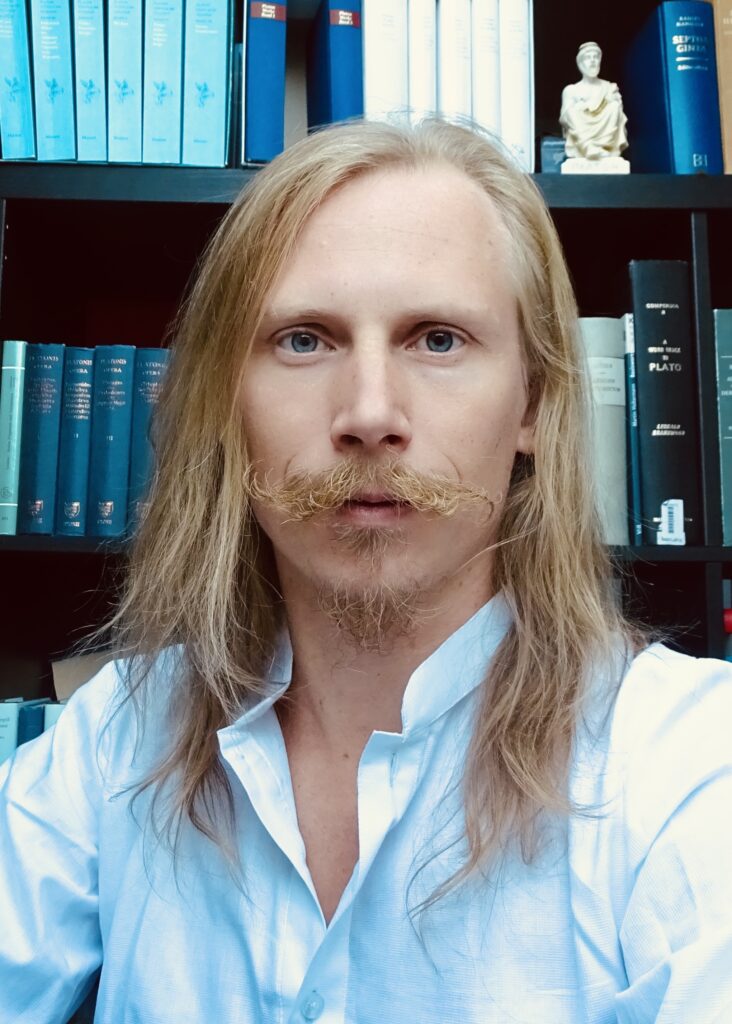
Sebastian F. Seeber
Head of Department / Lecturer
Sebastian F. Seeber studied Greek, Philosophy and Classical Philology at the Humboldt University of Berlin. Since 2025, he has been working on his PhD at the Universität Regensburg on Plato’s dialogue Cratylus. He teaches Greek at, amongst other places, the University of Würzburg (JMU) and is the founder of the Carpe Kairon Institute.
His work focuses on bringing ancient literature and poetry up to date and making them relevant to the present day, but particularly on researching and teaching Plato’s language and philosophy.